


Engineered to perform
A guide to the Xeno design
A clean break from convention
The modular Xeno hub is machined from aircraft-grade aluminium and features a double-axle, disc-side drive, a unique bearing layout, and more in our patent-pending Infinity Drive design.
By rethinking the traditional hub design, Xeno unlocks a range of surprising performance benefits.

DOUBLE-AXLE
By extending the freehub body all the way through the hub, it becomes what we call the drive shaft - a secondary axle with a much larger diameter than the primary axle.
Together, these two axles create an exceptionally stiff hub structure.

When landing jumps on a conventional hub, the axle bends, and the wheel can be felt to wobble or move from beneath you.
With the Xeno hub, the axle remains rigid and the wheel stays precisely alligned.
This stiffness also delivers additional advantages behind the scenes. Reduced axle flex helps lower internal drag and significantly increases the lifespan of the hub’s bearings and ratchet mechanism.


DISC-SIDE DRIVE
On the Xeno hub, the ratchet is not squeezed inside the hub shell. Instead, it sits on the opposite side of the hub, inside the brake disc, and is driven by the drive shaft.


On the Xeno hub, the ratchet is on the disc side of the hub.
This layout allows the ratchet to be significantly larger and lets it take advantage of the strength of the brake disc. The increased size spreads the loads more effectively and allows for more - and larger - pawls.

The result is a ratchet that is stronger, more reliable, and capable of faster engagement. When it eventually wears, it is also quick and easy to replace.
UNIQUE BEARING LAYOUT
The Xeno hub uses a unique double-axle bearing layout with two independent bearing pairs.
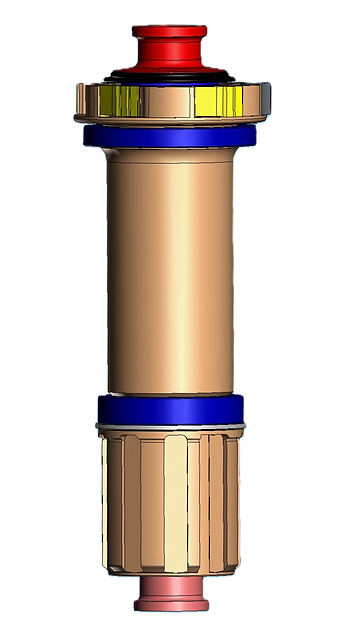

The pedal-bearing pair sit inside the drive shaft, on the axle.
The freewheel bearing pair sit on the drive shaft.
Each pair consists of what is known as a locating bearing and a floating bearing, positioned as far apart as possible to minimise bending of the axle.
Unlike conventional hubs - where systems often require 4 or 5 bearings to rotate together - the Xeno layout ensures that only two bearings are rotating at any one time.

The locating-floating bearing system also prevents unwanted bearing load. In many hubs, tightening the wheel onto the bike compresses the bearings, increasing friction. With Xeno hubs, tightening the system does not add unwanted load to the bearings.
These changes lower internal drag and increase bearing life.
MODULAR DESIGN
Built from 8 main precision-machined aluminium components, every part of the KOM hub is designed to be replaced, upgraded, or customised - without changing the rest.


Switching cassette standards? Just swap the cassette holder. No new hub required. This keeps costs down, reduces waste, and means your hub evolves with you rather than being replaced.
The same logic applies to aesthetics. Choose your hub shell colour, pick your endcap colour, and build a wheel that's unmistakably yours.
